
Accessibility statement.
The standard this website is built to, how it is tested, what still falls short, and what to do if something gets in your way.
Report a barrierA website that some people cannot use is not finished. That goes for a museum's website too, because it is often the first door a visitor tries.
The standard we build to.
This website is built to the Web Content Accessibility Guidelines (WCAG) 2.2 at level AA, published by the W3C. That standard was part of the plan from the first page, not an audit at the end.
Museums that answer to a public funder often see WCAG 2.1 AA named in their agreements. A site that meets 2.2 AA also meets 2.1 AA, and adds the newer criteria: larger tap targets, and keyboard focus that is never hidden behind other content.
What that means on this site.
- Structure
- Every page has one main heading, headings in order, and landmarks for the header, the content and the footer. Lists are lists and buttons are buttons, so a screen reader gets a page that makes sense.
- Keyboard
- Everything works with a keyboard alone: the visit planner, the menu, the calendar and every form. Focus is always visible. While the menu is open, Tab stays inside it and Escape closes it.
- Contrast and text size
- Text and its background meet the AA contrast ratios. With large text on a 320-pixel-wide phone, pages reflow without sideways scrolling and nothing slides under the header.
- Tap targets
- Buttons and links outside of sentences are at least 24 pixels square, and the main buttons are 44 or larger, so a thumb finds them.
- Colour
- Open and closed always carry a word and an icon, never colour alone. In Windows high-contrast mode, buttons and icons keep their edges.
- Motion
- Two things move: the visit slip slides in and the stamp lands. If your device asks for reduced motion, both simply appear. Nothing plays on its own or loops.
- Images
- Photographs that carry meaning have a written description. Decorative ones are marked so screen readers skip them.
- Without JavaScript
- Every page still reads with JavaScript turned off. The visit planner shows the hours and prices by season in place of its buttons.
- On paper
- The Visit page prints a one-page visitor card with the hours, the prices and the step-free way in.
How it is tested
Before a change ships, every page goes through automated checks: the axe rules for WCAG 2.2 AA, a contrast sweep, a count of tap targets, and a check of keyboard focus order. Each page is also drawn with large text, high contrast and reduced motion turned on. Then comes a keyboard walk by hand. Automated tools find only part of the problem, so passing them is where the work starts.
Where this site stands.
This site is held to the same standard as every site its builders make. These are the limits we know about today.
- Text over photographs
- Page titles sit on a panel over a photograph. Tools cannot measure that contrast, so it is checked by eye. If one is hard for you to read, that is a real miss, and we want to hear about it.
- Screen readers
- The structure and the names of every control are checked by machine and by hand. A full session with NVDA and VoiceOver is the next test.
- The 1931 school photo
- On a phone, the faces are small buttons, 24 by 28 pixels. That meets AA. It can still be fiddly, so “Show the faces” outlines every one, and Tab reaches each face in turn.
Found a barrier? Tell us.
If any part of this website is hard to use, with assistive technology or without it, tell us what page you were on, what you were trying to do and what you were using.
The Marrick Museum is invented, to show what a small museum's website can do, so there is nobody at its counter to take your note. The people who built the site will: Kootenay Made Digital, in British Columbia.
Every report gets the same treatment: the barrier is fixed first, then the fix is checked with the same kind of setup that hit the problem, and then you hear back about what changed. You get a reply within 24 hours.
The building itself.
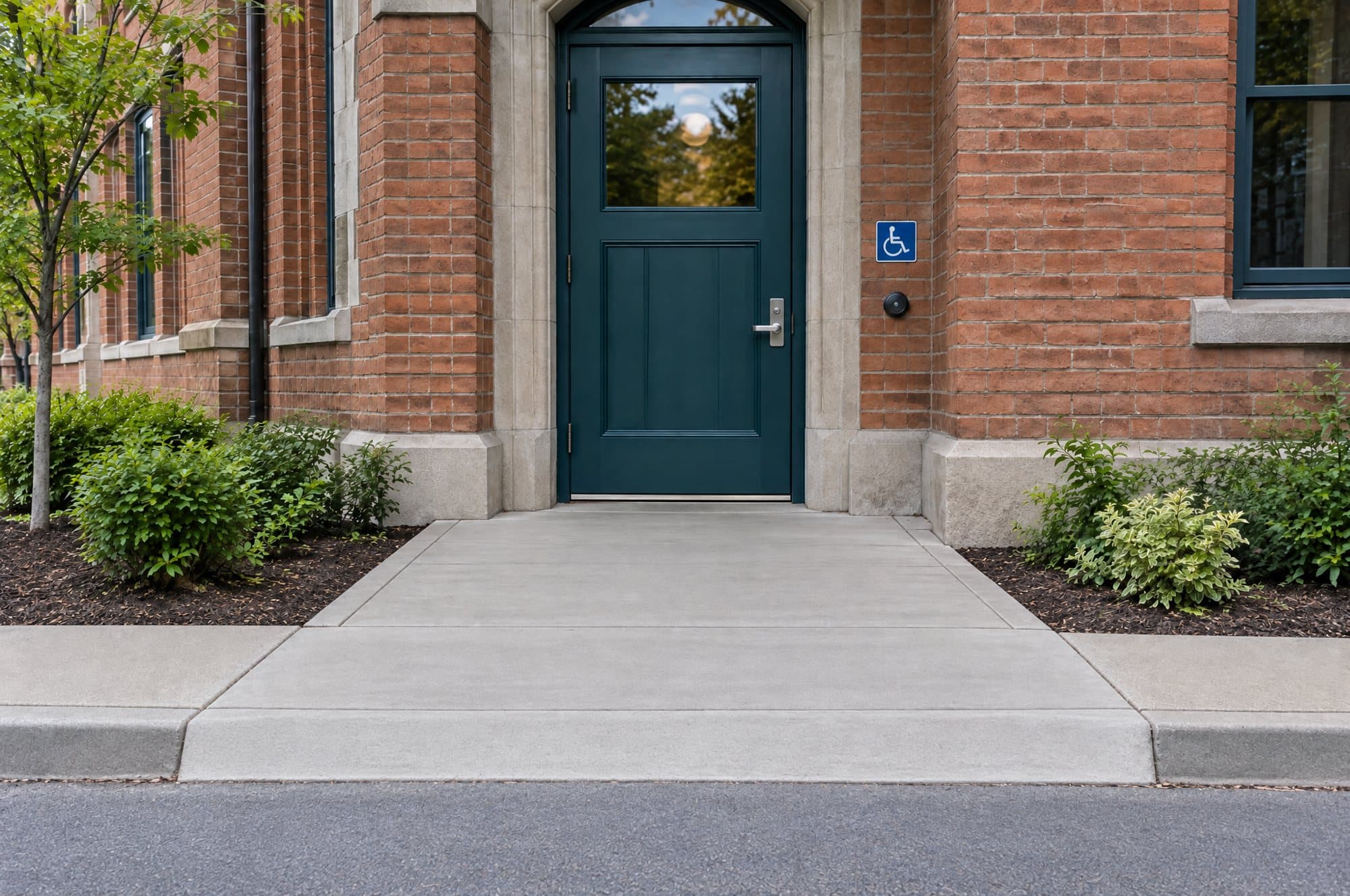
This page is about the website. For the museum, with photos of the side door, the lift and the washroom, see getting in and getting around. For a question about your visit, call the museum at 555-0142.